
State of the Telecommunications Industry
GRI 2-6Global Trends in the Development of Information and Telecommunication Technologies
According to the latest estimates by the International Telecommunication Union (ITU), there are approximately 5.5 billion Internet users worldwide – representing 68 % of the global population, up from 65 % the previous year. This points to continued growth in global digital engagement, although 2.6 billion people still remain offline.
Over 96 % of the world’s population is now covered by mobile broadband networks (3G and above), with more than half having access to 5G networks. ITU data also indicates that the number of fixed broadband subscriptions continues to grow. At the same time, the number of fixed telephone lines continues to decline, reflecting a global shift away from legacy technologies in favor of digital and mobile solutions.
These trends highlight not only the scale of the digital transformation but also the persistent digital divide – particularly in low-income countries, where connectivity remains significantly lower. Closing this gap remains a key challenge and priority for the global community..
Global Population Access to Telecommunications Networks and Technologies, in millions, as of year-end
|
Indicator |
2022 |
2023 |
2024 |
|---|---|---|---|
|
Number of fixed telephone lines |
877.7 |
860.6 |
839.8 |
|
Number of fixed broadband subscribers |
1,418.7 |
1,495.6 |
1,601.2 |
|
Number of mobile cellular subscriptions (SIMs issued) |
8,617.2 |
8,891.1 |
9,144.2 |
|
Number of active mobile cellular subscriptions (active SIMs) |
6,808.1 |
7,029.8 |
7,719.5 |
|
Population covered by mobile network (individuals) |
7,773.5 |
7,868.8 |
7,985.9 |
|
Population covered by 3G and higher mobile network (individuals) |
7,529.2 |
7,642.2 |
7,802.8 |
|
Number of individuals using the Internet |
5,132.2 |
5,416.9 |
5,508.8 |
|
Number of individuals owning a mobile phone |
5,056.0 |
5,227.8 |
5,434.4 |
Access to modern telecommunications services is directly linked to the economic well-being of the countries people live in. In countries classified by the World Bank as low-income (less than USD 1,145 GNI per capita), there are on average 26.5 Internet users per 100 inhabitants. In contrast, in high-income countries (above USD 14,005 per capita), this figure reaches 92.9. The most significant disparities between low- and high-income countries remain in the number of fixed telephone lines (0.9 vs. 29.4) and fixed broadband subscriptions (0.5 vs. 38.1) per 100 inhabitants. However, in 2024, these gaps began to narrow slightly due to the increasing shift toward wireless connectivity.
As of the end of 2024, Kazakhstan remains classified by the World Bank as an upper-middle-income country (GNI per capita between USD 4,516 and USD 14,005). The number of active mobile subscriptions in Kazakhstan reached 26.24 million in early 2024, equivalent to 133.1 % of the total population. This highlights the ongoing decline in fixed-line and broadband usage, alongside the continued growth in mobile service adoption – reflecting a steady transition to digital technologies.
Access to telecommunications services by income level (as of end-2024), per 100 inhabitants
|
Indicator |
World Average |
Low-Income Countries |
Lower-Middle Income Countries |
Upper-Middle Income Countries |
High-Income Countries |
Kazakhstan (2023) |
Kazakhstan (2024 |
|---|---|---|---|---|---|---|---|
|
Fixed telephone lines (per 100 inhabitants) |
9.5 |
0.8 |
2.4 |
11.2 |
28.7 |
13.2 |
15.0 |
|
Fixed broadband subscribers (per 100 inhabitants) |
21.0 |
0.6 |
5.2 |
33.5 |
39.0 |
14.3 |
18.0 |
|
Mobile cellular subscriptions (per 100 inhabitants) |
112.0 |
71.0 |
94.5 |
129.5 |
138.0 |
127.0 |
133.1 |
|
Mobile network coverage (%) |
98.0% |
91.1% |
98.9% |
99.6% |
99.6% |
99.0 |
99.0% |
|
3G or higher network coverage (%) |
95.6% |
80.3% |
95.3% |
98.1% |
99.5% |
97.7 |
97.7% |
|
Internet users (% of population) |
68.0% |
26.5% |
54.0% |
80.7% |
93.4% |
92.9 |
92.3% |
|
Mobile phone ownership (% of population) |
79.7% |
56.2% |
72.0% |
84.2% |
96.1% |
92.8 |
92.8% |
Kazakhstan’s Telecommunications Industry
Value of Telecommunication Services Provided, KZT billion over the period
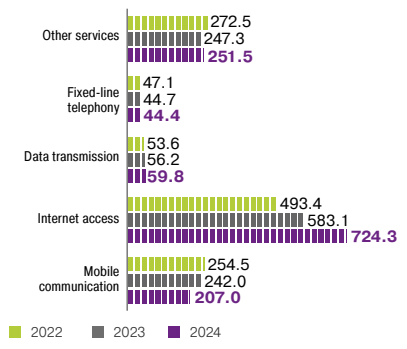
In 2024, the total value of services provided by telecommunications companies in Kazakhstan (excluding courier and postal services) reached KZT 1.4 trillion. The increase was primarily driven by the growing demand for both fixed and wireless Internet access, with revenue from these services rising from KZT 583.1 billion to KZT 724.3 billion. At the same time, the volume of mobile communication services saw a decline.
Change in Physical Volume of Telecommunication Services by Type, year-on-year
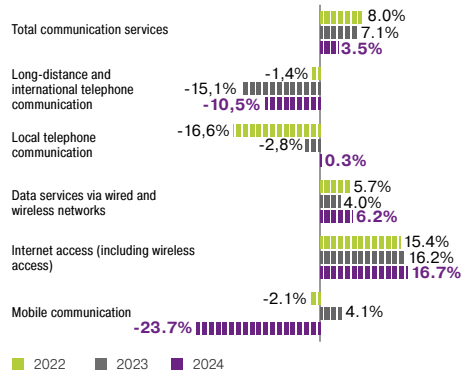
In 2024, the real growth of telecommunication services reached 3.5 %, down from 7.5 % the previous year.
The increase in the total volume of services in real terms was primarily driven by the growing demand for Internet access, while demand for other types of services has continued to decline gradually.
Number of Fixed-Line Telephone and Fixed Broadband Subscribers, million, end of period
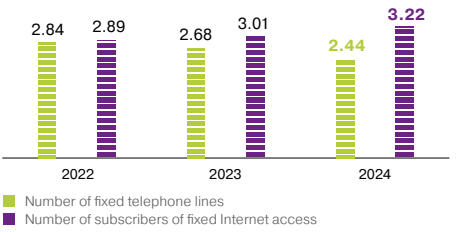
In the reporting year, the number of fixed telephone lines decreased from 2.68 million to 2.44 million, while the number of fixed broadband (FBB) subscribers increased from 3.01 million to 3.22 million. This reflects a continued long-term trend of declining fixed-line telephony usage and growing adoption of fiber-optic connections (FOL), which are actively replacing xDSL technology (broadband access via traditional phone lines).
Population and Territory Coverage by Mobile Networks as of Early 2024
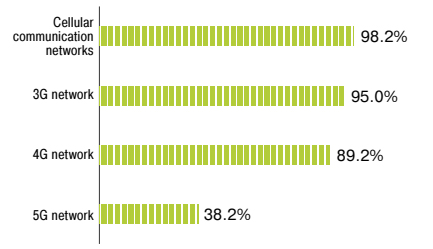
As of early 2024, mobile networks covered 98.2 % of Kazakhstan’s population. Specifically, 3G networks reached 95.8 % of the population, 4G – 89.2 %, and 5G – 38.2 %. Given the increasing demand for advanced mobile technologies, including IoT, and the government’s supportive policies, further expansion of 5G coverage is expected in the coming years.
Number of Mobile Subscribers and Mobile Broadband Users, Million end of period
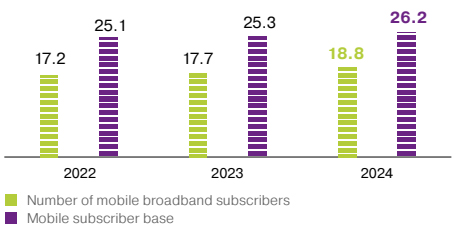
As of the end of 2024, the total mobile subscriber base in Kazakhstan – defined as the number of active SIM cards – reached 26.2 million, up from 25.3 million a year earlier. The number of mobile broadband subscribers also increased, rising from 17.7 million to 18.8 million.